Sunday, November 18, 2012

Photo time

Thus far the entirety of my blog has been written on my iPhone.  It is not exactly ideal for writing long blog posts but I am coping with writing the text itself.  The main disadvantage of using the iPhone is that I haven't been able to upload any of my photos from my SLR camera.  Today I have ventured to the internet cafe to attempt to show you some of my photos (with the added bonus that if I have my camera stolen like I did in South America I will at least have some of my favorite photos backed up).

I have taken a lot of black and white photos since I have been here.  This is just one.  If I get a decent internet connection anytime soon I'll upload some more.

The Nile on a beautiful evening as we overlooked it from the Adrift campsite.  I would seriously recommend the white water rafting, insane fun, especially the 15ft waterfall on the first rapid.


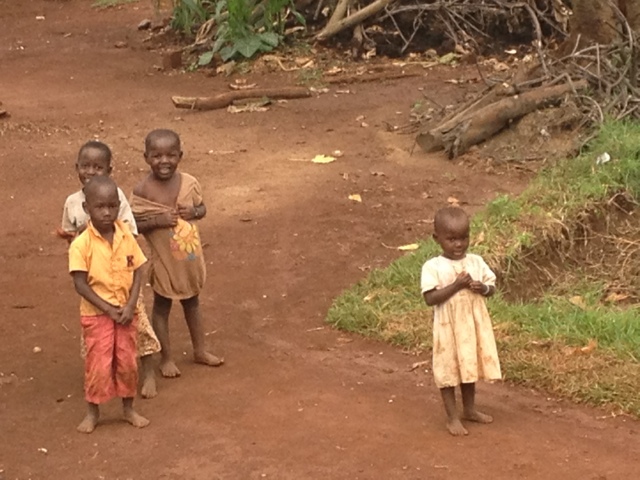
Children here are so photogenic. The half off, ripped tee shirt is a common sight.

This photograph was taken in Katosi, which was the "port" we left from for the trip out onto Lake Victoria.  Cows are literally tethered everywhere in Uganda.  In fact there are two cows referred to as the "rubbish tip cows" as they graze on one of the rubbish tips in Mukono.  Its no wonder that the beef tastes so strong here. 

These were some of the children that mobbed us when we arrived at the first island on Lake Victoria.  They were very intrigued to see photos of themselves on our cameras and couldn't stop giggling and laughing whenever we showed them their photos.

This is a photograph taken through the crack between the wooden boards of our accommodation on the island.  A snapshot of island life early in the morning.

I have hundreds more photos, but unfortunately the internet connection here is pretty slow and for some reason blogger is really slow at loading these.  I will try and load some more photos at some stage.  As the saying goes, a picture tells a thousand words.

Thursday, November 15, 2012

Don't eat monkeys

Is one of the pieces of advice being issued by the Ministry of Health following a new outbreak of Ebola.

The outbreak is actually quite close to where I'm living so I'll definitely be taking on this advice (and staying away from dead people).

Ebola outbreaks are always widely reported on internationally (and I only heard about the latest one because I was on the BBC website). While undoubtedly a scary virus given the very high death rate, the numbers can be quickly thrown out of proportion. There was another Ebola outbreak in Uganda earlier in the year that killed 16. This compares to the estimated 5 people killed daily in boda boda accidents. I'm not sure what the figures are, but I guarantee a lot more people are dying daily from untreated malaria, diarrhoea and malnutrition than by Ebola.

Nasty viruses actually seem pretty prevalent here (the is also an outbreak of another haemorrhagic virus, Marburg, at present). Advice for that one is to avoid bat caves...

In fact, any aliment seems to thrive here. I got a small cut on my leg from a school table falling on it four weeks ago. It was actually more like a scrape but it still isn't healed thanks to a superficial infection. I have also developed a nice fungal infection on my feet, charming I know.

The kids at school are like a hot house of infection too, most had a hacking cough when I was last there (which I also managed to acquire). Lice, worms and ringworm are common too. (In fact I have been told to deworm on departure as a precaution...)

The other thing that I have noticed with a lot of children is the extremely extended stomach on small children (almost like a pregnant belly). This is usually attributed to worms or malnutrition. It was also insightful to see the diseases that formed part of the school science curriculum: kwashiorkor (lack of protein) and marasmus (lack of carbohydrates) are two nutrition related diseases I'd never heard of which children here learn about (of course it may just be saying something about my ignorance).

Anyhow, I digress from the Ebola outbreak and avoiding eating monkeys. The moral of the post is that Ebola is bad but so are many other health and nutrition related issues facing the country.

Tuesday, November 13, 2012

Boda bodas, taxis and the African way of walking

Getting from A to B in Uganda can really be quite an experience. The roads are pretty damn awful, it is hot and every ride in a minibus (called a taxi) seems to involve switching seats at least five times. (And I don't even know where to begin with the boda bodas).

So here goes. A run down on each of the three primary ways of transporting oneself in Uganda.

Walking: certainly the safest option in terms of being in control of how quickly one travels (such control non existent in taxis and almost non-existent on boda bodas). Having said that the general walking pace is slowwww (especially when compared to London walking pace). People really are on African time here.

Walking slowly is also a bit of a necessity given the complete lack of footpaths, street lighting and drainage systems and the complete abundance of potholes. It is really easy to fall over here (and yes I have fallen flat on my face on one occasion). Other hazards I have encountered when walking are crossing the road and the local crazy guy who hits me in the face whenever he sees me.

Taxis: as I mentioned taxis are actually minivans which operate via a 'semi bus like' system. They travel all over the place. To catch one, you flag it down on the side of the road. Once you have (1) checked the taxi is going where you need to go and (2) negotiated the price, the only remaining action is to squeeze yourself in (sometimes easier said than done). The taxis all have a sign painted on saying that they are licensed to carry up to 14 passengers. In reality around 20 are crammed in. The record I have witnessed is 23 (refer to photo taken inside a taxi to give you an indication). Uncomfortable to say the least. Other goods carried include chickens, raw fish, sugar cane and mattresses. The suspension in the vehicles is completely gone (due to the fact the drivers seem to go the same speed on both tar-sealed roads and pot-hole riddled dirt roads). It is possible to hit your head on the roof when the pot holes are particularly violent.

To get off the taxi you pay your fare and ask the conductor to stop at the next stage. Once the passenger has got off, the driver will commence tooting as he drives until the next passenger on the road flags down the taxi. While there is inevitably a lot of changing seats and stopping and starting, taxis do the trick and they are pretty affordable (although many Ugandans would disagree with me). The hour trip from Mukono to Kampala usually costs 2000 shillings (equivalent to 50p).

Boda bodas: finally but certainly not least are boda bodas. Bodas are motorbikes which are found absolutely everywhere here in Uganda. While more expensive than taxis, they are much quicker as you can get the driver to take you exactly where you want to go. They are also much more efficient to take in Kampala as the bodas can wind in and out of traffic to avoid the notorious traffic jams.

Like taxis, people and goods are crammed onto bodas. If I were a boy I'd probably be able to tell you what size engines they have (but I can't) but they aren't large motorbikes and it isn't uncommon to see a driver with three passengers passing by. We often take them with two passengers when visiting smaller villages where taxis don't go which is quite squished enough for me. It is also tricky for a female to ride bodas whilst wearing a skirt (although women here almost never wear trousers). Tradition requires one to adopt a side saddle type approach...which I always find a little nerve racking. The other major downside of bodas is that you either get covered in dust, or if it's raining, wet. I have also discovered that sun glasses are a must just to keep the dust and bugs out of my eyes.

While transport here leaves a lot to be desired, as a traveller I shouldn't complain, it is cheap, I'm not tied to bus timetables and I can get pretty much anywhere in the country. The biggest impediment to getting around easily here is the sorry state of the roads...

Friday, November 9, 2012

Island life

This week involved a trip to a small island out on Lake Victoria to go HIV testing. Wow, what an eye opener - I really feel like I saw how the other half live and Mukono feels like absolute civilisation in comparison.

The trip was organised by the director of a project that another 'The Real Uganda' volunteer is at. In all there were four volunteers and about six Ugandans who went on the trip.

Lake Victoria is huge and it really does feel like the sea. The furtherest islands still within Ugandan jurisdiction are a 12 hour boat ride away. Thankfully the island we stayed on was only 2 hours away.

The lake was pretty choppy on the trip out and the boats we traveled on weren't particularly sturdy (in fact permanent bailing seemed to be required). There were no life jackets and I spent a fair bit of time assessing which landmark I would swim towards if the boat sunk. Most Ugandans can't swim and are very fearful of the lake.

The communities on the islands vary in size, but all are small. There is no electricity, no cars (although of course there may be on some of the larger islands). The houses are what I would classify as shacks. Most people on the islands are fishermen. Not many women and children live out there, although the town we stayed had enough children to support a school. The children were all very excited to see us and they couldn't stop giggling when we showed them photos of themselves.

I think our girlish mzungu ways showed when we all shrieked at the spiders and bugs in our accommodation. In fact the four of us insisted sharing two to a bed rather than face a night alone in a spider infested shack.

The testing itself took place on a different island. We prepared a spiel on HIV for the crowd that gathered which was interpreted for us. It was delivered outside under the shade of a tree (no such thing as a hall/health clinic or school on this island). The testing was then done in one of the little shacks on the island by one of the group. Everyone who tested received post testing counseling by two trained HIV counselors. It was worrying to see how little people knew about HIV, questions from the crowd included people asking whether HIV could be spread by shaking hands.

Seeing the results themselves was also more difficult than I imagined. Of the 80 people who were tested, 9 showed positive results. While 80 tested, many present at our talk did not, fear of HIV is alive and well. I was particularly relived when a small girl and her mother both tested negative.

While there is access to retro-viral drugs here, they are only available in certain places. Given the location of island and particularly the cost involved getting to the health clinics I'd say that it is pretty unrealistic that all those people who did test positive will get the treatment they need.

The public health emphasis here is certainly on containing HIV rather than treating it and you can understand that stance taken by the government. Hopefully one day there will be an effective vaccine.

All in all it was a very insightful trip which once again left me extremely grateful for the life I lead.

Sunday, November 4, 2012

The joys of coffee, hot showers, non-African food and Skype

The other volunteers who I normally hangout with in the weekends went to Kigale to go chimpanzee trekking this weekend. (I'm planning on going at the end of my trip as I have ten days to fill in before I head to Kenya.) Left to my own devices I decided to head to Kampala for a weekend of mzungu treats.

High on the priority list was some decent coffee and non-African food. Yesterday I went to a cool little cafe/gallery/farmers market for lunch. Hmm the joys of eggs florentine and carrot cake should not be underestimated! The place was full of expats and it really made me think how different expat life in Kampala is to living out of Kampala (where I am forced to live a much more African lifestyle - bucket showers and pit latrines included).

In terms of African capitals, Kampala is by all accounts one of the better ones. Yes there are areas of slums, but these are relatively contained and the nice areas really are very nice. It is also comparatively safe. I feel happy walking around the city centre (it will be interesting to compare it to notorious Nairobi).

The scariest aspect is the appalling traffic. Taxes on car imports were reduced a few years ago resulting in an explosion of traffic flow which the roads are quite simply not equipped to deal with. The traffic is even scarier when weaving in and out of it on the back of a boda boda (the motorbikes used as the primary means of travel). I avoid using them whenever possible!

I followed up lunch with a joyfully hot shower at the backpackers I am staying at. Washing hair in a bucket of cold water just isn't as satisfying as a hot shower.

I rounded out my Saturday with wood fired pizza and beers out at an Irish pub, (is it some kind of rule that every city in the world must have an Irish pub??) with a bunch of expats I met.

Today I have marvelled at the joys of my iPhone and technology as I have managed to talk to my parents, both my sisters and three friends. The Skype connection was so excellent to NZ I would have sworn I was talking to someone just down the road. It is really awesome being able to talk to people about all my experiences. It helps me to remember that there is a whole other world out there.

On the agenda this week is a trip to one of the islands on Lake Victoria to do HIV testing which should be interesting.

Friday, November 2, 2012

Child sacrifice

As of 8 October 2012 I became an aunty for a third time. Having my new niece born whilst I am in Uganda has inevitably made me think how blessed she is to have been born to the parents she has, and in the country she has been born into, compared to a child here.

This feeling has been exacerbated over the last couple of days as I have discovered more about the occurrence of child sacrifice in Uganda.

While I had certainly heard of witch doctors existing here, and had expected some 'odd' practices to be undertaken by them, I wasn't prepared for the reality that child sacrifice is alive and well. In fact the current child sacrifices occurring in Uganda appear to be a somewhat recent phenomenon (different to historical ritualistic human sacrifices common in Africa).

I had always assumed that if children were being kidnapped and murdered as sacrifices that it would only occurr in the deepest villages in the country. Sadly not. Child sacrifice has turned into a business, whereby people (often businessmen) will pay 'healers' or sham witch doctors money to ensure the prosperity of their businesses or ventures. Sometimes the sacrifice of a goat or other animal will be sufficient, but since approx 2005 there have been a number of cases where children have been abducted by these witch doctors to sacrifice. According to reports sometimes the children are buried alive in the foundations of new buildings. In other cases they are mutilated or blood taken. Of course the 'doctor' who performs the sacrifice charges a significant fee. Hence a so called business in child sacrifice has sprung up over the past few years (a uniquely Ugandan way to take out insurance for a new business).

The numbers of official reported cases are low, about 30 a year. But the figures are thought to be much higher.

I had not expected such practices to occur in Kampala or Mukono as they are both urban and relatively developed. But due to their relative prosperity child sacrifice is reportedly common in these areas (as there are more people building and starting businesses who can afford to pay a healer to make the sacrifice).

There are reports that if a child is scarred or has pierced ears that they are not suitable for sacrifice. I noticed a lot of girls had pierced ears at school and I wonder if this is why? I'll have to ask someone next week.

EACO's most recent program has been to educate communities in the area how to protect against child sacrifice (and hopefully to dispel some of the myths about it). Things like water collection present a real issue given children most often collect water early in the morning or after school when it is dark.

I find it extremely hard to reconcile a practice like this occurring in today's world, particularly where it seems that relatively educated people believe the myths.

If you want to read more about the practice and work being undertaken by EACO check out:
http://www.asafeworldforwomen.org/partners-in-africa/partners-in-uganda/eaco/studies.html

This BBC article is also worth a read: http://www.bbc.co.uk/news/world-africa-15255357

Thursday, November 1, 2012

Reality check

I got a reality check on what life is really like for many Ugandans living in poverty today. While a lot of children at the school are living in poverty the worst I saw was them having to walk down the road to fetch water and those being sent home for school fees. When in uniform that generally look pretty smart and obviously I didn't see their homes.

My first day with EACO allowed me a glimpse into home life for many. The organisation's work includes training people (often widows) in things like pig and chicken raising and mushroom growing so that the women have a means of generating income (with start up costs either funded through EACO or raised by micro finance).

Today's home visits were to visit four women EACO have trained, but specifically to talk about water and sanitation. The first and last visits were the most memorable.

The first was memorable because she had a lovely tidy home, had put her five children through school, and had particularly healthy looking animals. It was also interesting as I saw the water hole which she collects all her water from (as per photo). Contamination is an issue with this water source as animals also use this water hole. Even where piped water is available people often will not use it due to its expense. Water bores really are needed in so many places still.

The last woman we visited had probably the most harrowing story. While I wouldn't have guessed from the visit, she is a widow with eight children. She is also HIV positive. Apparently when her husband died other family members tried to take her belongings, land and house. She managed to retain them and has subsequently had help to have a proper weather proof house built and training to start a piggery (with very healthy looking pigs). She has also planted an impressive garden (cabbages, eggplants, coffee, passion fruit, cassava, and tamirillos). (This was on the advice of EACO to try and ensure the children received sufficient nutrients in their diet).

The current issue facing the family is a lack of any latrine (at present they are using plastic bags and burying all waste) as the previous one collapsed in. Despite all the hardships she is one of the favourites with the organisation as she always takes on the advice given to her. A very resilient woman. Hopefully some money can be found to help build a toilet for her and her family.

The day really brought home just how huge the gap is between developed countries and developing countries. I also learnt more about the shocking practice of child sacrifice (another thing EACO is working to reduce) which you can expect to hear further about soon.